
In Tarot, the Knight of Wands can be a tricky card to pin down. When I first learned the meaning of Knight of Wands from the little white book, it was
“Bold and bound for glory, this knight may rush in where angels fear to tread. He is more susceptible to failure than those who never take a chance, and yet, fortune seems to follow him and keep him from true harm. He will champion any righteous cause and pursue any path that promises adventure.”
Giulia F. Massaglia (2019). Golden Art Nouveau Tarot. Lo Scarabeo, Torino, Italy. (Instructions by Lunaea Weatherstone)
This, in my opinion, was a wonderful introduction to the Knight of Wands, but it is not everything, nor was it meant to be. The instructions in the pamphlet inside each Tarot box is meant to be a starting point of an endless journey.
Knight of Wands Meaning

There are several aspects of reading for each card, including the numbers associated with a card, the colors, layout, symbology, and elements. When I read for others, I take many of these aspects into account. The way I choose what to pay attention to is unconscious. Those that occur to the reader at the time are most likely to be the relevant aspects that matter for that particular reading.
There are many aspects of each card. If you took fifty Tarot readers and asked for the be-all-end-all set of aspects that you should pay attention to, well, to be honest, you would probably get a bunch of cranky responses saying, “There are no absolutes in Tarot.” And they would be right to say so. Here are the attributes I pay attention to in my readings. I hope they help you in your practice:
- Suit
- Number/role
- Element
- Color
- Symbology
- Layout
- Emotional content
- Action
In this post, I will walk you through each aspect as it relates to the Knight of Wands.
Suit
The suit is Wands, of course. Wands are the suit of creativity, inspiration, that spark of life, the moment an idea hits your mind and possibilities abound. Additionally, the late Rachel Pollack characterizes the suit thus:
“Whether they win or lose, Wands constantly struggle, not so much because of actual problems or goals, but just for the love of conflict, of the chance to use all that energy.”
(Pollack 1980.)
On one hand, Wands are about energy and drive. On the other hand, energy and drive bring Wands into conflict and struggle. Wands also are “the Way to Spirit in movement, action, living for the joy of living.” (Pollack 1980.)
Wands are a suit of struggle, of creativity, of energy.
Number/role
What number or role the card plays in the suit matters as well. For numbered cards, numerology can be a helpful guide. For court cards, the station in society is one way to look at how the card functions in its suit. Esther Lisa Freinkel Tishman, PhD, BCC (2019) discusses the court cards and notes that they “personify the deck.” They provide an “embodiment” or how the suit “breathes and walks.” When Tishman addresses the knights, she labels them “Compassion.” She also elaborates that knights are for “when we simply have to do something – when our body leaps into action almost before we know it.”
Knights are about movement, action, compassion.
Element
It is well established that suits have elements, as do court cards. Wands are commonly associated with fire, and knights are also associated with fire. The doubling up of the element of fire means something. Massaglia’s (2019) description is particularly astute in capturing the sheer fiery nature of the Knight of Wands. “Rush[ing] in where angels fear to tread” indeed.
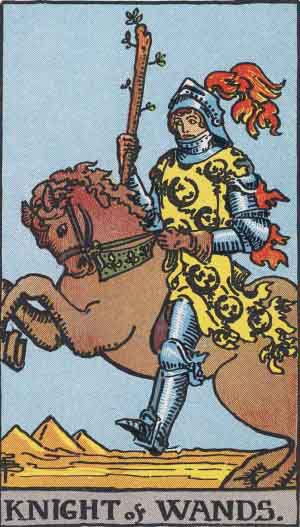
Often, this is described in the form Element in the suit of element. In this case: Fire in the suit of fire. How would Tarot embody fire in a fiery way? Well, it could do that with a leaping horse, red feathers, a sense that the knight is literally burning, as in the Pamela Coleman Smith depiction.
The Knight of Wands is Fire in the Suit of Fire.
Color
We’re starting to get a little more specific to the Knight of Wands, now. Above, I have been keeping aspects separate from each other, to the extent possible. Those barriers start breaking down at this point.
I noted above that red figures into the color scheme for Knight of Wands. So do oranges and yellows. The knight in the Pamela Coleman Smith depiction wears a red feather and a torn red cape, giving the impression that the knight could be on fire. The horse is orange in some depictions, and the landscape in the background is yellow. Color feeds into the element, but it also elaborates on it. The orange horse adds to the sense of passion that already is present in the element of fire.
Symbology
One example of symbology in the Knight of Wands is the salamander tunic. In Seventy-Eight Degrees of Wisdom, Pollack notes the salamanders, who represent fire. The King of Wands features salamanders that have their tails in their mouths, indicating completion. In the Knight of Wands, the salamanders are not full circles, but their mouths are closer to their tails in the Knight than in the Page, who symbolizes immaturity.
The knight is on his journey to maturity.
Layout
The knight is wholly in the foreground in Pamela Coleman Smith’s Knight of Wands. The focus is entirely on him, and we may miss the pyramids and desert in the background.
The knight holds a center space in the card, overshadowing the arid background.
Emotional content
The knight in the picture may seem to be concentrating hard on guiding his steed. The horse is rearing up on its hind legs, indicating power and energy.
The knight needs to concentrate to make sure he can successfully navigate the territory that “angels fear to tread.”
Action
The poses in the image suggest strength, movement, and power, which fits well with the themes mentioned above.
Overall interpretation
The Knight of Wands means Fire in the Suit of Fire. It is a fierce card, indicating brave movement toward a goal. The knight is willing to struggle to get where he wants to go, and he is not afraid to boldly forge a new path.
References
Freinkel Tishman, E.L. (2019). Mindful Tarot: Bring a Peace-Filled, Compassionate Practice to the 78 Cards. Llewellyn Publications. (See https://www.calyxcontemplative.com/)
Massaglia, G.F. (2019). Golden Art Nouveau Tarot. Lo Scarabeo, Torino, Italy. (Instructions by Lunaea Weatherstone) (See https://www.llewellyn.com/product.php?ean=9780738763460)
Pollack, R. (1980). Seventy-Eight Degrees of Wisdom. Weiser Books. (See http://www.rachelpollack.com/)
 Sean's Journeys
Leave a comment